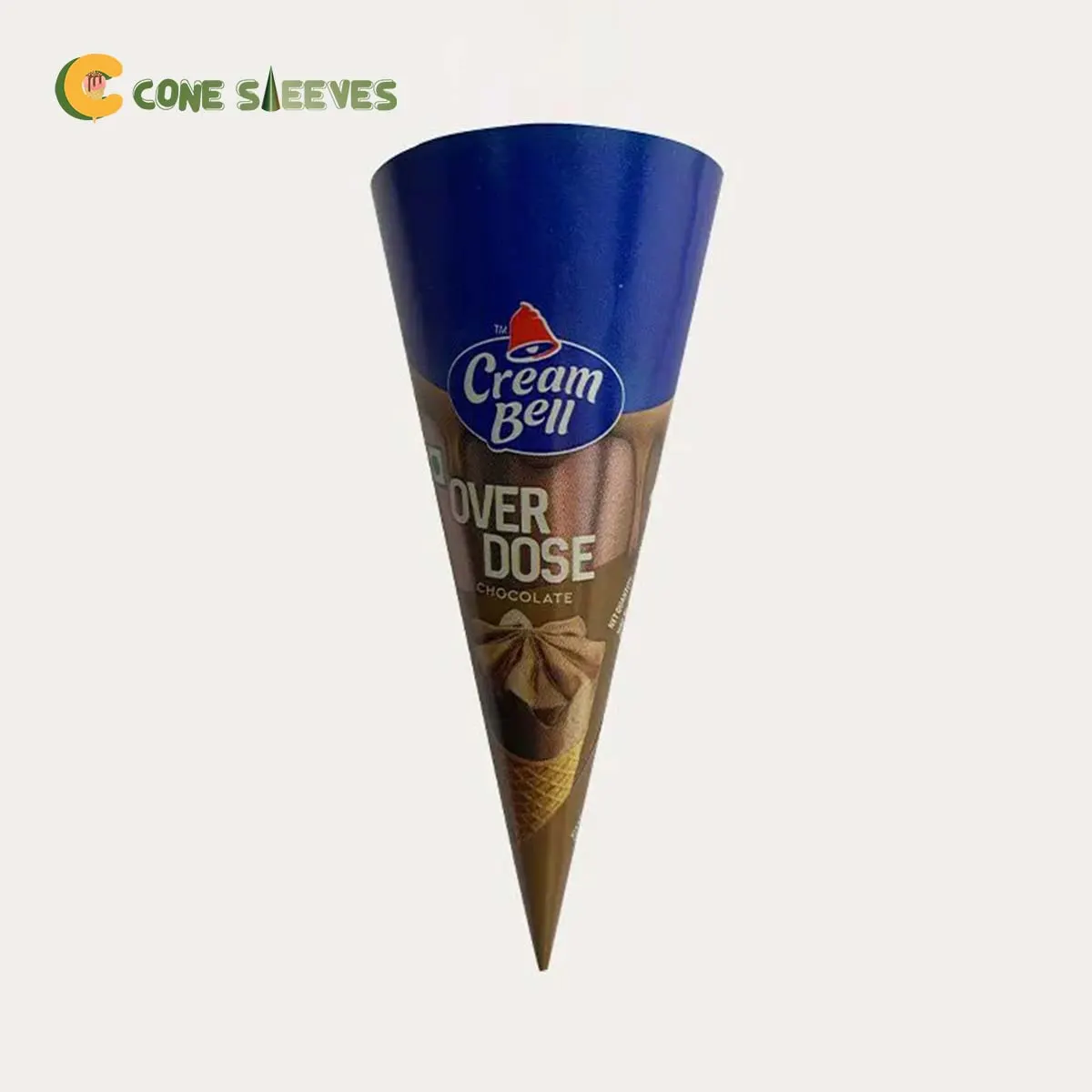
What a Sleeve Is Actually For
Ask a scoop shop owner why they want cone sleeves and the answer is usually branding. Ask their staff and the answer is usually mess.
Both are right, and the second one is what makes the first one work. A sleeve keeps a customer's hand off a wafer that is about to be dripped on, which is a real service improvement, and it happens to carry your name while doing it.
Understanding that ordering matters, because a sleeve that photographs beautifully and slides down the cone will not survive a fortnight on your counter.
The Three Mistakes Almost Every First Order Makes
These come up so often they are worth naming directly:
- Sizing from the cone's catalogue description rather than from a physical cone, which produces a wrap that slides.
- Ordering a year's supply before knowing the real usage rate, which ties up cash and often locks in a size that turns out to be wrong.
- Choosing a finish on a screen rather than in the hand, which is how gloss sleeves end up on counters where hands are always damp.
All three are avoidable with a physical sample and a smaller first order, which is why we suggest both.
Estimating How Many You Need
Most businesses either wildly over-order or run out in six weeks. This gets closer.
Count Cones, Not Customers
Take a full week of till data and count cone servings specifically, separating them from tubs and other formats.
Find Your Peak Week, Not Your Average
If you are seasonal, your busiest week may be three or four times your quietest. Order against the peak or you will run out during it.
Decide Your Reorder Interval
How often you are willing to place an order. Twice a year is common; quarterly suits businesses with tight storage.
Multiply and Add a Margin
Peak weekly usage, times the weeks between orders, plus around fifteen per cent. Flat-packed stock is cheap to hold and expensive to run out of.
Seasonality Is Bigger than Most People Plan For
A UK ice cream business can do half its annual trade in three months. That is not a curve to smooth — it is two different businesses sharing a counter.
Ordering to an annual average leaves you short in July and overstocked in November. Ordering to a peak leaves you carrying stock through the winter, which for flat-packed sleeves costs almost nothing.
The second problem is much cheaper than the first.
Blackpool operators face this in an unusually sharp form, covered on how an extended seaside season changes stock planning.
One Sleeve or Two
Sites selling both waffle and cake cones need two dies, because the tapers differ enough that one sleeve cannot grip both.
That sounds like double the cost and usually is not. The artwork is designed once and laid onto both dies, and running both sizes in a single order shares the setup between them.
The decision worth making deliberately is whether you need a children's size as a third. If children's cones are more than a small fraction of your trade, they generally justify their own sleeve.
We set out when a children's size earns its own die rather than treating it as automatic.
What Dessert Brands Need That Scoop Shops Do Not
A dessert bar serving loaded waffles, crepes and cookie dough alongside cones has a wider packaging problem. The cone sleeve is one item among several, and consistency across them matters more than any single one.
The practical consequence is to order them together. Printed months apart on different stocks, the same brand colour drifts enough to be visible when two items sit side by side on a table.
It usually costs less as well, because the setup is shared across one job rather than repeated.
This is the whole argument for ordering trays and sleeves as one coordinated set.
A Sensible First Order
Send three cones. Ask for one size, one design and a quantity covering roughly six months at your peak rate.
Take the flat sample, wrap it round a real cone in your own shop, and have the person who will actually use them assemble twenty in a row.
If all of that works, you have a specification you can reorder against for years. If it does not, you have found out at the cheapest possible moment.
What to Check When the First Delivery Arrives
Ten minutes with the first box saves a season of irritation:
- Wrap one around a cone from your current stock, not the samples you sent us.
- Have the person who will use them assemble twenty in a row and time it.
- Leave a filled, sleeved cone on the counter for ten minutes and look at the board.
- Check the sleeve against a cone from a different batch, where you have one.
- Photograph a finished cone under your own lighting before deciding you like the print.
Anything that fails here is worth telling us about immediately, while the batch and the run are still identifiable.
Reordering Without Repeating the First Order
The second order is the one where the economics improve. The die already exists, the artwork is signed off, and you now know your real usage rather than an estimate.
That is the moment to ask for a price against your annual volume rather than a single run. A quantity that looked small in January often justifies a cheaper print method once the whole year is taken together.
It is also the moment to check whether the specification survived a full season. If the board softened in August or the sleeve loosened on a new batch of cones, a reorder is when that gets fixed for nothing.
Questions
How many cone sleeves does a typical scoop shop use?
It varies far too much for a useful average — a seaside kiosk in August and a suburban shop in November are different businesses. Count a week of actual cone servings from your till data and scale from that.
Should our first order be small or large?
Smaller than feels efficient. A first order is partly a test of whether the size, board and finish are right, and finding out on six months of stock is much less painful than on two years of it.
Do we need sleeves for tubs as well as cones?
A tub does not need a sleeve, though a printed tub or a lid label does the same branding job. If tubs are a large share of your trade it is worth quoting both together for consistency.
How much stock should a first order cover?
Roughly six months at your peak rate. Enough to learn from, not so much that a wrong specification becomes a two-year problem.
Do we need a children's size straight away?
Only if children's cones are a meaningful share of trade. Many sites add it at the second order once they have real figures.
What is the commonest first-order mistake?
Sizing from a catalogue description rather than a physical cone. It produces a sleeve that slides, and there is no fixing it afterwards.
Should we order sleeves and holders together?
If you use both, yes. Cutting them from the same cone measurements is what makes the holder grip where the sleeve does not, and ordering together shares the setup cost.
How do we handle a seasonal business?
Order against your peak rather than an average, and remember flat-packed stock costs almost nothing to hold through the winter.
Can we test a design before a full run?
Ask about printed samples at quote stage. What is available depends on the print method your job runs on, and digital work makes them considerably easier than a conventional press does.
When should we reorder?
Before the last case, and ideally with your annual volume in hand so we can price the better print method.