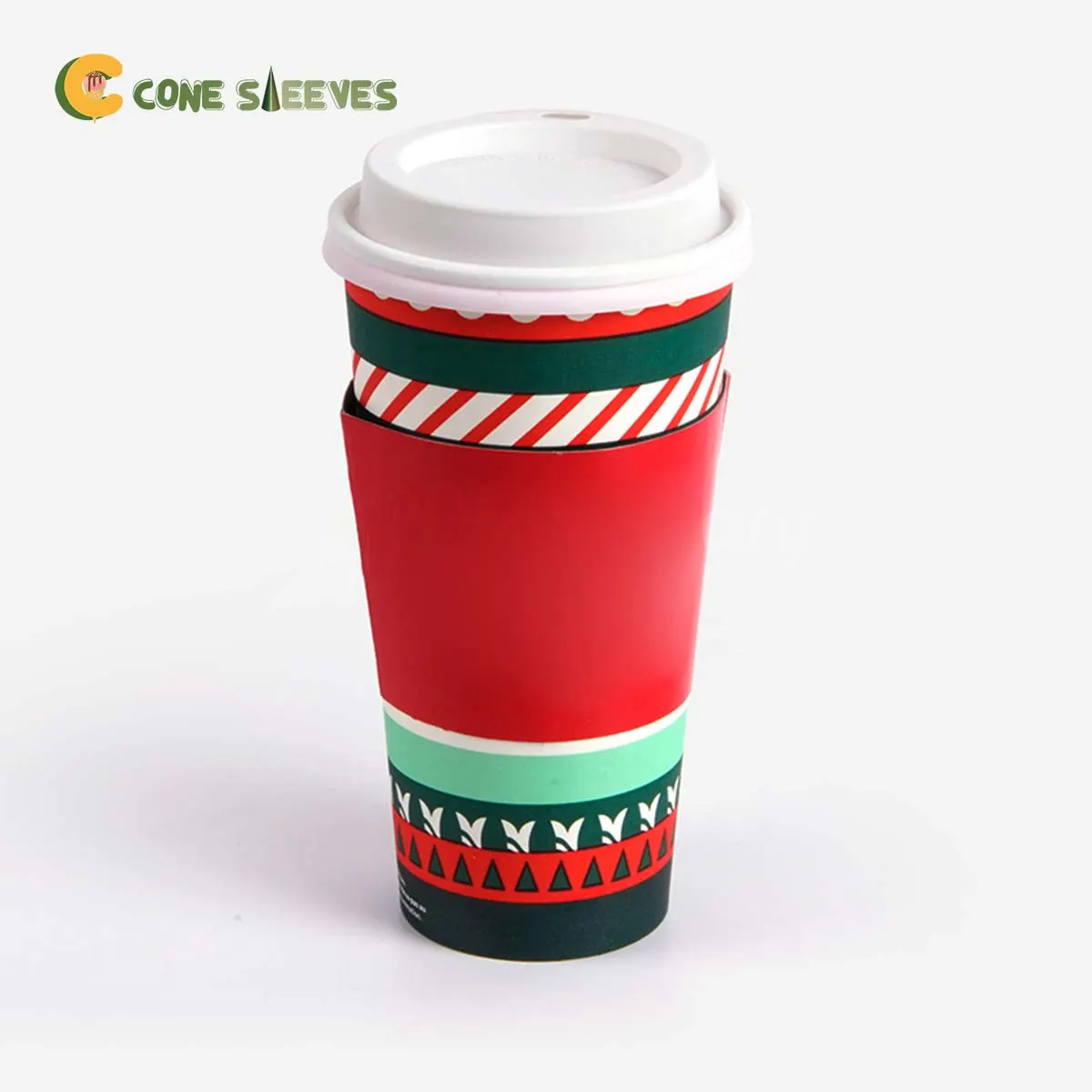
Why the Sleeve Usually Beats the Cup
Printed cups carry die costs and minimum quantities that a single café often cannot justify. A printed sleeve carries neither, works with plain cups already in the cupboard, and can change four times a year without writing off stock.
It also brands a cup you have not committed to. If you switch cup supplier next year, the sleeve very likely still fits, whereas a pallet of printed cups is a pallet of printed cups.
For a café branding its takeaway offer for the first time, this is almost always where to start.
Sizing: Circumference, Not Volume
A sleeve is cut to the distance around a cup at the point where a hand grips it, roughly a third of the way down from the rim.
That is not the same as the cup's stated volume. Two cups both sold as 12oz can differ by several millimetres in circumference, which is enough for one sleeve to grip and the other to spin.
Send us a cup, or the brand and size code printed on the base. Either removes the guesswork; a stated volume does not.
The measurement method is set out on measuring a cup at the grip point.
Corrugated or Flat Board
The two constructions feel different and suit different drinks.
| Corrugated | Flat board | |
|---|---|---|
| Insulation | Real — air channels in the flute do the work | Adds grip more than protection |
| Print detail | Texture softens fine type and small marks | Smooth, holds detail cleanly |
| Cold drinks | Absorbs condensation well | Can soften unless laminated |
| Storage per thousand | Bulkier | Very compact |
| Suits | Very hot drinks on single-wall cups | Iced drinks, tea, double-walled cups |
If your cups are already double-walled, the insulation argument disappears and flat board is usually the better choice.
Designing for a Cup That Is Held
A right-handed grip covers roughly a third of the sleeve for the life of the drink:
- Repeat key elements around the circumference so something always faces the viewer.
- Keep the wordmark clear of the glued seam, which sits differently on every cup.
- Put a QR code where a thumb does not land, or it will not scan.
- Remember that kraft board shifts colour, so check a proof rather than judging from screen.
- Leave the design uncluttered — a sleeve is read at arm's length by a stranger, not studied.
A single small logo placed once is the most common design mistake, because it faces away as often as towards.
How Many Sizes You Actually Need
One sleeve rarely covers more than two adjacent cup sizes. A sleeve cut for a 12oz cup is slack on an 8oz and will not go over a 16oz.
Most cafés running three cup sizes end up with two sleeves. That is worth planning for rather than discovering after the first order.
It is also an argument for reducing your cup range. Two cup sizes and one sleeve is a simpler operation than three cups and two sleeves, and customers notice the difference far less than you would expect.
If you are reconsidering your sizes, which cup volumes cover which drinks sets out what each one is for.
Using Seasonal Designs Well
The cheapest branding change a café can make is a new sleeve design on the same cups. There is no die to pay for, no cup stock to clear and no change at the counter.
Digital printing makes several designs in one run affordable, so a set of four seasonal sleeves is genuinely achievable for an independent.
The one thing worth avoiding is printing a year on them. Undated artwork can be used again; dated artwork becomes waste on 1 January.
What to Send When You Enquire
A cup from your current stock, the number of sizes you carry, your realistic annual usage, and whether your trade is mostly hot or mostly iced.
Those four things let us quote properly. Without them, any price is a guess, and the most common consequence is a sleeve that does not grip the cups you actually use.
Mistakes Worth Avoiding on a First Sleeve Order
These come up often enough to be worth naming:
- Ordering to a stated cup volume instead of a measured circumference, so the sleeve spins.
- Placing a single logo once, which faces away from the viewer about half the time.
- Choosing corrugated for the insulation on cups that are already double-walled.
- Printing a year onto a seasonal design that would otherwise have run again.
- Buying a year of stock before knowing how many sleeves a week you actually use.
All five are cheap to avoid at quote stage and expensive to find out about on a pallet of finished sleeves.
When It Is Worth Moving on to Printed Cups
Sleeves stop being the obvious answer at a certain volume. Once a group is getting through enough cups that the die and minimum quantity on a printed cup are spread thinly, the maths changes.
The crossover is not a fixed number, because it depends on the print method, the number of sizes carried and how often the design changes. A business changing its artwork four times a year stays with sleeves far longer than one running a single design.
The useful move is to ask for both prices against your genuine annual usage rather than your next order. That comparison usually settles it in one email.
Ordering a First Run of Sleeves
Four steps, and the first one removes most of the risk.
Post Us a Cup from Your Current Stock
Not a size, and not a photograph. The circumference at the grip point is what the sleeve is cut to.
Decide Corrugated or Flat Board
Corrugated for very hot drinks on single-wall cups; flat board where the cup already insulates or the drink is cold.
Lay the Design Out to Repeat
A hand covers roughly a third of the sleeve, so key elements need to appear more than once around it.
Order to a Season, Not a Year
Count a typical week first. Most cafés are surprised by their actual usage in one direction or the other.
Questions
Will a sleeve fit cups we already buy?
That is the intention, and it is why we ask for a cup rather than a size. The sleeve is cut to the circumference of your actual cup rather than to a nominal volume.
Do we need sleeves if our cups are double-walled?
Not for heat. Plenty of cafés still use them for branding, because a printed sleeve on a plain double-walled cup is far cheaper than printing the cup itself.
How many sleeves does a café get through?
That depends entirely on how many takeaway hot drinks you sell and whether every one gets a sleeve. Count a typical week before ordering rather than estimating annually — most people are surprised in one direction or the other.
Do we need to change cups to use sleeves?
No, and that is the point. A sleeve is cut to the cup you already buy, so nothing in your supply has to change.
How many sleeves will we get through?
Count a typical week of takeaway hot drinks and whether every one gets a sleeve. Most people are surprised either way.
Can we use sleeves on cold drinks?
Yes, with a coated surface. Cold cups sweat, which is a different problem from heat and needs specifying for.
What if we change cup supplier?
Send a cup from the new supplier before reordering. Two cups sold as the same volume can differ enough to matter.
Is a corrugated sleeve worth the extra?
On single-wall cups with very hot drinks, yes. On double-walled cups the insulation argument largely disappears.
Should we print cups instead?
Once volumes justify the die and minimum quantity. Ask for both prices against your genuine annual usage.
Can we run a seasonal sleeve?
Easily, and it is the cheapest branding change a café can make — no die and no cup stock to clear.